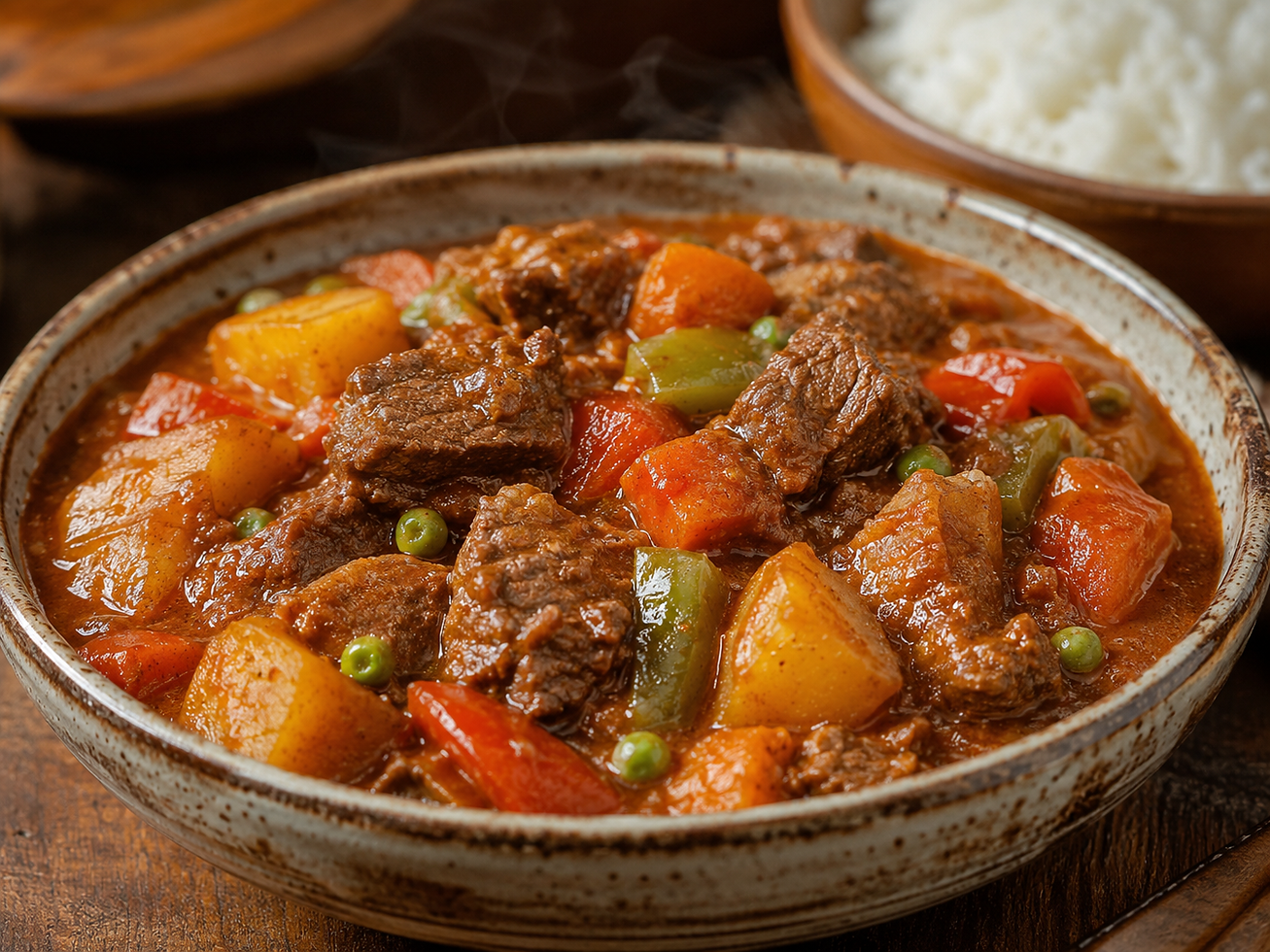
Beef Caldereta Recipe with UmamiBee Dish Lifter and Going Bananas – Hearty Filipino Beef Stew

MotherBee's Recipe Rundown
Taste: Bold, rich, deeply savoury tomato-based beef stew with a briny olive accent and liver spread richness.
Texture: Melt-apart beef, soft golden potatoes, and vibrant capsicum in a thick, glossy sauce.
Ease: Intermediate. The long braise requires patience but the technique is simple.
Why You'll Love It: This is the dish you make when you want to impress. It announces a celebration the moment the smell hits the room.
Hello, I am MotherBee, and Beef Caldereta is the dish that announces a special occasion before anyone even sits down. That rich, dark sauce, the tender beef, the olives, the capsicum. Every bite tells you this meal was made with care.
Today we are making Caldereta with UmamiBee Dish Lifter as the saute base and Going Bananas as part of the tomato-based sauce. Two jars that build a sauce deeper and more complex than anything made with plain tomato paste.
Origin and Historical Background
Caldereta comes from the Spanish caldera meaning a large cooking pot. Introduced during the colonial period, it was originally made with goat (kambing) in the Spanish and Portuguese tradition. Filipino cooks adapted it over centuries, adding liver spread as a thickener, green olives for briny contrast, and banana ketchup alongside the tomato base.
Caldereta is historically a prestige dish, reserved for fiestas and major celebrations. The use of beef signals abundance. Making it properly requires time, quality ingredients, and patience, all of which signal respect for the people at your table.
What Makes Filipino Caldereta Unique?
The liver spread is what separates Caldereta from every other Filipino tomato stew. It thickens the sauce, adds richness and iron-forward depth, and gives the dish its distinctive character. The green olives add a briny bitterness that cuts through the fat and keeps every bite interesting.
Modern Versions and Regional Variations
Traditional Caldereta uses goat or beef with liver spread, olives, and capsicum. Modern versions include pork, chicken, and vegetarian adaptations with jackfruit or chickpeas. Some cooks add chilli or cheese for different flavour profiles.
Pampanga: The most elaborate version with goat, liver spread, olives, capsicum, and sometimes cheese and chilli.
Visayas: Some versions use coconut milk alongside the tomato base for a creamier sauce.
Recipe Card
Beef Caldereta with UmamiBee Dish Lifter and Going Bananas
Preparation Time: 20 minutes
Cooking Time: 1.5 to 2 hours (45 minutes in pressure cooker)
Serves: 6 to 8
Tools needed: Large heavy-bottomed pot or Dutch oven with lid, wooden spoon, sharp knife and chopping board.
Ingredients
1kg beef chuck or shin, cut into large cubes
2 (30g) tablespoons UmamiBee Dish Lifter (Umami Paste)
4 (80g) tablespoons UmamiBee Going Bananas Banana Ketchup
1 cup (250ml) beef broth or water
2 (30g) tablespoons liver spread or liver pate
2 medium (300g) potatoes, peeled and quartered
1 medium (120g) carrot, cut into chunks
1 medium (120g) red capsicum, cut into squares
1 medium (120g) green capsicum, cut into squares
½ cup (60g) green olives, pitted
2 tablespoons soy sauce
3 pieces dried bay leaves
2 tablespoons cooking oil
Instructions
Step 1. Season beef with pepper. Heat oil over high heat and sear in batches for 3 to 4 minutes per side until well browned. Do not crowd the pot.
Step 2. Reduce heat to medium. Add Dish Lifter and stir for 30 seconds.
Step 3. Add Going Bananas, soy sauce, and broth. Scrape up any browned bits from the bottom of the pot.
Step 4. Return beef and add bay leaves. Bring to a boil then reduce to a very low simmer. Cover and braise for 1 hour.
Step 5. Add potatoes and carrots. Cover and cook for 20 more minutes.
Step 6. Stir in liver spread until fully incorporated. Cook uncovered for 10 minutes.
Step 7. Add capsicum and olives. Cook for 10 to 12 minutes until capsicum is just tender.
Step 8. Remove bay leaves. Taste and adjust with soy sauce if needed. Rest 5 minutes then serve over steamed rice.
Tips for Success
Sear the beef in batches. Crowding the pot drops the temperature and causes the beef to steam instead of brown. Browning in batches over high heat creates the Maillard reaction, which builds the rich, dark flavour base that defines this dish.
Use beef chuck or shin, never lean cuts. The collagen in chuck and shin converts to gelatin during the long braise, giving the sauce its body and the meat its fall-apart tenderness. Lean cuts become dry and stringy.
Add liver spread in the last 20 minutes. Extended cooking makes liver spread turn bitter. Adding it near the end preserves its characteristic richness and allows it to thicken and enrich the sauce without developing an off flavour.
Add capsicum and olives late. Olives added too early make the sauce overwhelmingly salty. Capsicum added early loses its colour and sweetness. Both go in the final 10 to 15 minutes only.
Caldereta tastes better the next day. Like most Filipino braises, the flavours develop and mellow overnight as the fat emulsifies further into the sauce. Make it the day before if you can. Reheat gently with a splash of broth.
Common Questions
Can I use a pressure cooker?
Yes. Brown the beef first then braise under pressure for 45 minutes. Release naturally then continue with the vegetable and liver spread steps on the stovetop.
Can I skip the liver spread?
You can but the sauce will be thinner and lack the characteristic depth that defines Caldereta. If you cannot find liver spread, a tablespoon of smooth chicken liver pate from a deli makes an excellent substitute.
The sauce is too salty. What do I do?
Olives are very salty. Reduce the soy sauce significantly when using olives and taste before adding any extra seasoning. Adding a diced potato to the sauce also helps absorb excess salt.
Can I make this with pork or chicken?
Yes. Pork shoulder works beautifully with a 45-minute braise. Chicken thighs need only 30 minutes. Both produce a rich, flavourful Caldereta.
Storage and Food Safety
Refrigerator: Store in an airtight container for up to 3 days. Freeze without potatoes for up to 2 months. Reheat gently with a splash of broth as the sauce thickens considerably when chilled.
Reheat to 75°C. Cool completely before refrigerating.
Ingredient and nutrition notes
Per-serving nutrition values have not been calculated and verified for this recipe. Nutrient levels vary with ingredient brands, cooking yields and portion sizes. Check product labels for sodium and allergens, and follow safe food handling practices.
Ingredient and nutrition notes
Per-serving nutrition values have not been calculated and verified for this recipe. Nutrient levels vary with ingredient brands, cooking yields and portion sizes. Check product labels for sodium and allergens, and follow safe food handling practices.
MotherBee's Notes
Never rush Caldereta. The entire dish is built on patience. Slow heat, a long braise, and a willingness to wait for the beef to become something extraordinary. The moment you try to speed it up, you lose everything that makes this dish worth making.
#BeefCaldereta #Caldereta #FilipinoFood #UmamiBee #UmamiBeeNZ #GoingBananas #BeefStew #PinoyFood #NewZealandFilipino #ComfortFoodNZ
A note from MotherBee
My food science background taught me to look closely at how ingredients, heat, fermentation and time create flavour. UmamiBee brings that understanding into simple products that help home cooks make satisfying food quickly.
Cook with UmamiBee
Ready to try it? Find UmamiBee Dish Lifter Original in the UmamiBee store. You can also explore UmamiBee Going Bananas.
Comments